了解vuex核心概念请移步 https://vuex.vuejs.org/zh/
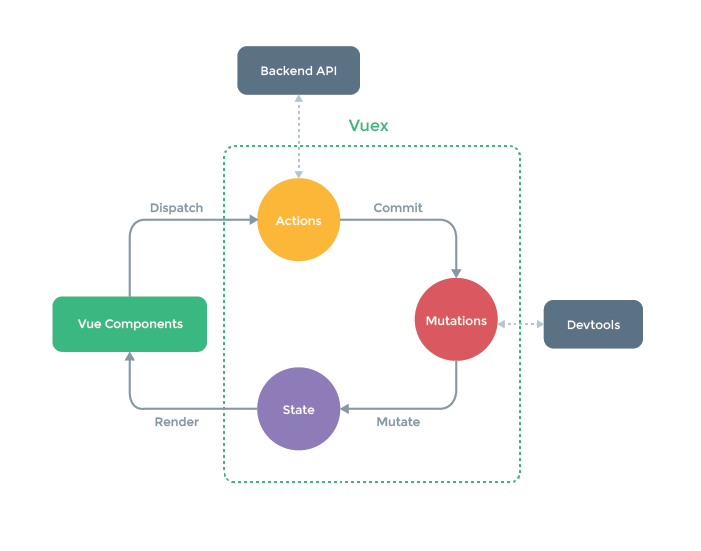
一、初始vuex
1.1 vuex是什么
vuex 就是把需要共享的变量全部存储在一个对象里面,然后将这个对象放在顶层组件中供其他组件使用- 父子组件通信时,我们通常会采用
props + emit 这种方式。但当通信双方不是父子组件甚至压根不存在相关联系,或者一个状态需要共享给多个组件时,就会非常麻烦,数据也会相当难维护
1.2 vuex中有什么
const store = new Vuex.Store({
    state: {
        name: 'weish',
        age: 22
    },
    getters: {
        personInfo(state) {
            return `My name is ${state.name}, I am ${state.age}`;
        }
    }
    mutations: {
        SET_AGE(state, age) {
            commit(age, age);
        }
    },
    actions: {
        nameAsyn({commit}) {
            setTimeout(() => {
                commit('SET_AGE', 18);
            }, 1000);
        }
    },
    modules: {
        a: modulesA
    }
}
|
个就是最基本也是完整的vuex代码;vuex 包含有五个基本的对象
state:存储状态。也就是变量;getters:派生状态。也就是set、get中的get,有两个可选参数:state、getters分别可以获取state中的变量和其他的getters。外部调用方式:store.getters.personInfo()。就和vue的computed差不多;mutations:提交状态修改。也就是set、get中的set,这是vuex中唯一修改state的方式,但不支持异步操作。第一个参数默认是state。外部调用方式:store.commit('SET_AGE', 18)。和vue中的methods类似。actions:和mutations类似。不过actions支持异步操作。第一个参数默认是和store具有相同参数属性的对象。外部调用方式:store.dispatch('nameAsyn')。modules:store的子模块,内容就相当于是store的一个实例。调用方式和前面介绍的相似,只是要加上当前子模块名,如:store.a.getters.xxx()
1.3 vue-cli中使用vuex的方式
目录结构
├── index.html
├── main.js
├── components
└── store
    ├── index.js          # 我们组装模块并导出 store 的地方
    ├── state.js          # 跟级别的 state
    ├── getters.js        # 跟级别的 getter
    ├── mutation-types.js # 根级别的mutations名称(官方推荐mutions方法名使用大写)
    ├── mutations.js      # 根级别的 mutation
    ├── actions.js        # 根级别的 action
    └── modules
        ├── m1.js         # 模块1
        └── m2.js         # 模块2
|
state示例
const state = {
    name: 'weish',
    age: 22
};

export default state;
|
getter示例
getters.js示例(我们一般使用getters来获取state的状态,而不是直接使用state)
export const name = (state) => {
    return state.name;
}

export const age = (state) => {
    return state.age
}

export const other = (state) => {
    return `My name is ${state.name}, I am ${state.age}.`;
}
|
mutation-type示例
将所有mutations的函数名放在这个文件里
export const SET_NAME = 'SET_NAME';
export const SET_AGE = 'SET_AGE';
|
mutations示例
import * as types from './mutation-type.js';

export default {
    [types.SET_NAME](state, name) {
        state.name = name;
    },
    [types.SET_AGE](state, age) {
        state.age = age;
    }
};
|
actions示例
异步操作、多个commit时
import * as types from './mutation-type.js';

export default {
    nameAsyn({commit}, {age, name}) {
        commit(types.SET_NAME, name);
        commit(types.SET_AGE, age);
    }
}
|
modules–m1.js示例
如果不是很复杂的应用,一般来讲是不会分模块的
export default {
    state: {},
    getters: {},
    mutations: {},
    actions: {}
}
|
index.js示例(组装vuex)
import vue from 'vue';
import vuex from 'vuex';
import state from './state.js';
import * as getters from './getters.js';
import mutations from './mutations.js';
import actions from './actions.js';
import m1 from './modules/m1.js';
import m2 from './modules/m2.js';
import createLogger from 'vuex/dist/logger';
vue.use(vuex);
const debug = process.env.NODE_ENV !== 'production';
export default new vuex.Store({
state,
getters,
mutations,
actions,
modules: {
m1,
m2
},
plugins: debug ? [createLogger()] : []
});
|
最后将store实例挂载到main.js里面的vue上去就行了
import store from './store/index.js';

new Vue({
  el: '#app',
  store,
  render: h => h(App)
});
|
在vue组件中使用时,我们通常会使用mapGetters、mapActions、mapMutations,然后就可以按照vue调用methods和computed的方式去调用这些变量或函数,示例如
import {mapGetters, mapMutations, mapActions} from 'vuex';
export default {
computed: {
...mapGetters([
name,
age
])
},
methods: {
...mapMutations({
setName: 'SET_NAME',
setAge: 'SET_AGE'
}),
...mapActions([
nameAsyn
])
}
};
|
二、modules
在 src 目录下 , 新建一个 store 文件夹 , 然后在里面新建一个 index.js
import Vue from 'vue'
import vuex from 'vuex'
Vue.use(vuex);

export default new vuex.Store({
    state:{
        show:false
    }
})
|
在 main.js 里的代码应该改成,在实例化 Vue对象时加入 store 对象
import store from './store'
new Vue({
el: '#app',
router,
store,
template: '<App/>',
components: { App }
})
|
这样就把 store 分离出去了 , 那么还有一个问题是 : 这里 $store.state.show 无论哪个组件都可以使用 , 那组件多了之后 , 状态也多了 , 这么多状态都堆在 store 文件夹下的 index.js 不好维护怎么办 ?
- 我们可以使用
vuex 的 modules , 把 store 文件夹下的 index.js 改成
import Vue from 'vue'
import vuex from 'vuex'
Vue.use(vuex);
import dialog_store from '../components/dialog_store.js';
export default new vuex.Store({
modules: {
dialog: dialog_store
}
})
|
这里我们引用了一个 dialog_store.js , 在这个 js 文件里我们就可以单独写 dialog 组件的状态了
export default {
    state:{
        show:false
    }
}
|
做出这样的修改之后 , 我们将之前我们使用的 $store.state.show 统统改为 $store.state.dialog.show 即可
- 如果还有其他的组件需要使用
vuex , 就新建一个对应的状态文件 , 然后将他们加入 store 文件夹下的 index.js 文件中的 modules 中
modules: {
dialog: dialog_store,
other: other,
}
|
三、mutations
对vuex 的依赖仅仅只有一个 $store.state.dialog.show 一个状态 , 但是如果我们要进行一个操作 , 需要依赖很多很多个状态 , 那管理起来又麻烦了
export default {
state:{
show:false
},
mutations:{
switch_dialog(state){
state.show = state.show?false:true;
}
}
}
|
使用 mutations 后 , 原先我们的父组件可以改为
<template>
  <div id="app">
    <a href="javascript:;" @click="$store.commit('switch_dialog')">点击</a>
    <t-dialog></t-dialog>
  </div>
</template>

<script>
import dialog from './components/dialog.vue'
export default {
  components:{
    "t-dialog":dialog
  }
}
</script>
|
使用 $store.commit('switch_dialog') 来触发 mutations 中的 switch_dialog 方法
四、actions
多个 state 的操作 , 使用 mutations会来触发会比较好维护 , 那么需要执行多个 mutations 就需要用 action 了
export default {
state:{
show:false
},
mutations:{
switch_dialog(state){
state.show = state.show?false:true;
}
},
actions:{
switch_dialog(context){
context.commit('switch_dialog');
},
}
}
|
那么 , 在之前的父组件中 , 我们需要做修改 , 来触发 action 里的 switch_dialog 方法
<template>
  <div id="app">
    <a href="javascript:;" @click="$store.dispatch('switch_dialog')">点击</a>
    <t-dialog></t-dialog>
  </div>
</template>

<script>
import dialog from './components/dialog.vue'
export default {
  components:{
    "t-dialog":dialog
  }
}
</script>
|
- 使用
$store.dispatch('switch_dialog') 来触发 action 中的 switch_dialog 方法。
- 官方推荐 , 将异步操作放在
action 中
五、getters
getters 和 vue 中的 computed 类似 , 都是用来计算 state 然后生成新的数据 ( 状态 ) 的
- 假如我们需要一个与状态
show 刚好相反的状态 , 使用 vue 中的 computed 可以这样算出来
computed(){
    not_show(){
        return !this.$store.state.dialog.show;
    }
}
|
那么 , 如果很多很多个组件中都需要用到这个与 show 刚好相反的状态 , 那么我们需要写很多很多个 not_show , 使用 getters 就可以解决这种问题
export default {
state:{
show:false
},
getters:{
not_show(state){
return !state.show;
}
},
mutations:{
switch_dialog(state){
state.show = state.show?false:true;
}
},
actions:{
switch_dialog(context){
context.commit('switch_dialog');
},
}
}
|
我们在组件中使用 $store.state.dialog.show 来获得状态 show , 类似的 , 我们可以使用 $store.getters.not_show 来获得状态 not_show
- 注意 :
$store.getters.not_show 的值是不能直接修改的 , 需要对应的 state 发生变化才能修改
六、mapState、mapGetters、mapActions
很多时候 , $store.state.dialog.show 、$store.dispatch('switch_dialog') 这种写法很不方便
- 使用
mapState、mapGetters、mapActions 就不会这么复杂了
<template>
<el-dialog :visible.sync="show"></el-dialog>
</template>
<script>
import {mapState} from 'vuex';
export default {
computed:{
...mapState({
show:state=>state.dialog.show
}),
}
}
</script>
|
相当于
<template>
  <el-dialog :visible.sync="show"></el-dialog>
</template>

<script>
import {mapState} from 'vuex';
export default {
  computed:{
    show(){
        return this.$store.state.dialog.show;
    }
  }
}
</script>
|
mapGetters、mapActions 和 mapState 类似 , mapGetters 一般也写在 computed 中 , mapActions 一般写在 methods 中